04 · Linux internals
SysCV
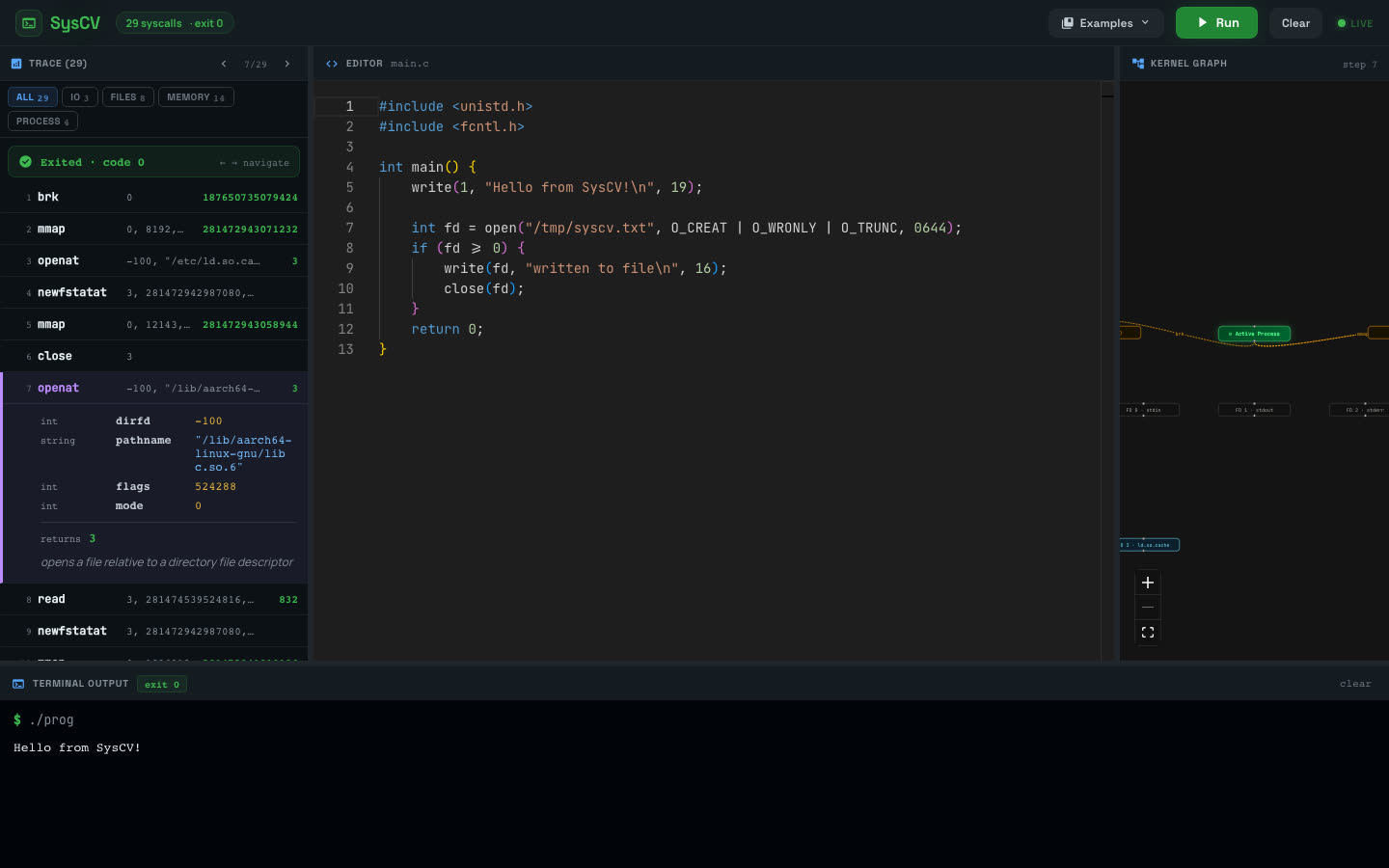
Watch a C program talk to the kernel, one system call at a time.
See it
The problem
System calls are where a program actually touches the machine, and they are invisible. strace prints a wall of text; nobody learns the kernel from that.
Numbers, with dates
- 10 of 10end-to-end scenarios pass (file I/O, memory, fork, signals, exec, output flood, SIGSEGV)tests/test_comprehensive.js, 28 Oct 2026
- About 60 / 40syscall definitions for x86-64 / ARM64table_amd64.go (62) and table_arm64.go (40)
- One weekstart to finish, 9 commits, all minegit history, 9 to 15 Apr 2026
How it works
- 01 · write
Write C in the browser
A Monaco editor and one Run button. Nothing to install but Docker.
- 02 · trace
Trace under ptrace
The program runs in a Linux container; every syscall entry and exit stops the tracee so registers can be read.
- 03 · hydrate
Hydrate the arguments
Raw registers become paths, buffers and flags, with a plain-English line for each call.
- 04 · replay
Step through the kernel
Collect, then replay: step back and forth while the kernel graph grows and shrinks with the program.
What I built
- A Go server that compiles your C with gcc and runs it under ptrace inside a Linux container.
- Architecture-specific register reading for x86-64 and ARM64 to recover each call’s arguments and return value.
- A replayable timeline and a kernel graph where file descriptors, heap growth and reads and writes appear as the program makes them.